Are Seagulls Protected in the UK in 2026?
Yes, and the law on this is absolute. Every gull species living wild in the UK holds full legal protection right now, in 2026, just as it has for decades. If you kill one, injure one, wreck a nest, or smash an egg without proper written authorisation, you have committed a criminal offence. There are no loopholes, no common-sense exceptions, and no get-out clause for homeowners at the end of their tether.
The Legislation Behind the Protection
The principal piece of law governing all of this is the Wildlife and Countryside Act 1981. It covers every wild bird in the UK without exception, and gulls sit firmly within its scope. Northern Irish residents fall under the Wildlife (Northern Ireland) Order 1985, which runs parallel to the main Act and carries equivalent force.
Scotland and Northern Ireland impose stricter duties than England and Wales. In those nations, even reckless harm to a gull counts as an offence. You do not need to have intended the harm. If a reasonable person could have foreseen it and you failed to act differently, you can still face prosecution. In Northern Ireland, disturbing a bird on its nest, regardless of any physical damage caused, is itself an offence.
The Mediterranean Gull sits under Schedule 1 of both pieces of legislation, placing it in the highest tier of protection. Approaching too closely to a nesting Mediterranean Gull, even without touching the nest, can constitute a criminal act.
Why Seagulls Need Protecting At All
Most people find the idea of protected seagulls baffling. Walk through any seaside town in summer, and gulls appear to be absolutely everywhere, bold as brass, stealing sandwiches, screaming from rooftops, colonising car parks. The numbers in towns and cities have unquestionably grown. But that urban rise masks something far more serious happening out on the coast.
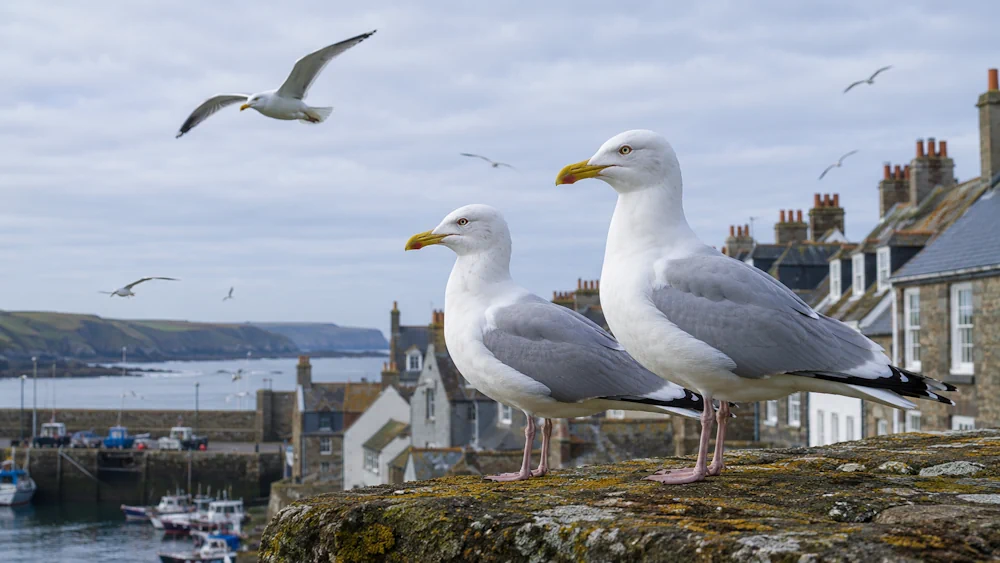
The Herring Gull, which is the large pale bird most people picture when they think of a seagull, now sits on the UK Red List of Birds of Conservation Concern. That is the most serious category, reserved for species facing severe and measurable long-term decline. UK breeding Herring Gull numbers dropped by 72% between 1969 and 2014. That is not a rounding error. That is nearly three-quarters of a national breeding population gone within a human lifetime.
The Lesser Black-backed Gull carries Amber List status, and significant drops have been recorded at key breeding colonies. At South Walney in Cumbria, numbers fell by 88% between 1997 and 2015 alone. The Kittiwake, another familiar coastal gull, is also Red Listed.
Gulls have moved into towns and cities not because urban life suits them, but because their traditional coastal habitats have deteriorated badly. Overfishing has stripped away food sources. Rising sea temperatures have shifted fish distribution. Predators and human disturbance have made coastal cliff colonies increasingly inhospitable. Rooftops offer a predator-free alternative with a reliable, if unhealthy, food supply courtesy of human waste. This is an adaptation born of necessity, not abundance.
When Control Is Legally Permitted
The law does acknowledge that there are situations where managing gull numbers becomes necessary. However, the threshold is deliberately high, and the process is tightly controlled.
Licences to disturb nests, destroy eggs, or, in extreme cases, kill birds can be issued by Natural England, NatureScot, Natural Resources Wales, or the relevant Northern Ireland authority. These licences apply in very specific circumstances: genuine risks to public health, threats to air safety, the prevention of serious agricultural damage, or the conservation of other wild species. Applications require demonstrating that every non-lethal option has already been attempted and has failed.
A noisy gull on your chimney stack does not meet the threshold. Dive-bombing during breeding season, while alarming and occasionally painful, will not secure you a licence on its own. Minor damage to roof tiles does not qualify either. The bar is deliberately high because these are declining wild birds, not agricultural pests.
Seagull Nests on Your Roof: What the Law Actually Allows
This is the situation that causes the most confusion for homeowners. Once a gull has built a nest on your roof and that nest contains eggs or chicks, your options under the law become extremely limited. You cannot move it. You cannot destroy it. Also you certainly cannot remove the eggs without a licence. The nest remains legally protected until the chicks have fledged and left of their own accord.
The only lawful approach before that point is to contact your local authority or a licensed pest control professional and discuss whether a licence application is appropriate for your specific situation.
Prevention, however, is entirely legal and strongly advisable. Gull-proofing your roof before nesting season is the single most effective strategy open to any homeowner. Heavy-gauge stainless steel spikes, tensioned wire systems, and professionally installed netting all deter gulls from settling without causing them any harm. Work should be completed before late winter, ideally by February, as gulls begin scouting rooftop nest sites earlier than most people expect.
The Legal Position on Feeding Gulls
No blanket national law currently bans the public from feeding gulls. However, local councils across England, Scotland, and Wales have introduced Public Spaces Protection Orders covering specific seafronts, promenades, and town centres. These orders carry the power to issue fixed penalty notices on the spot to anyone caught deliberately feeding gulls in the designated zone.
Beyond fixed penalties, anyone who persistently feeds gulls in a way that creates an ongoing nuisance for neighbours or surrounding businesses risks receiving a Community Protection Notice. Breach that notice and the fines escalate considerably.
From an ecological standpoint, feeding gulls in urban areas worsens the problem. It sustains artificially large urban populations, draws in additional breeding pairs, and conditions birds to associate humans with food, which is precisely what makes them bold and aggressive.
Penalties for Harming Protected Gulls
The consequences of breaking the Wildlife and Countryside Act 1981 are not trivial. Convictions can result in an unlimited fine and up to six months’ imprisonment per offence. Critically, each individual bird, each egg, and each nest counts as a separate offence. Someone who interferes with a rooftop colony containing multiple active nests faces multiple charges running concurrently.
Reports of people shooting gulls, poisoning them, or destroying roof nests without authorisation do reach the courts. Ignorance of the law is not accepted as a defence.
Practical Legal Steps for Managing Gull Problems
If gulls are causing real difficulties at your home or business, these are the lawful options worth pursuing.
Gull-proof your building outside the nesting season using professionally installed deterrents. Secure all waste in lidded, gull-resistant bins and never leave food waste accessible outdoors. If dive-bombing during breeding season poses a specific risk to vulnerable individuals, document the situation thoroughly and contact Natural England or your devolved equivalent to discuss whether a licence application is warranted. Engage only licensed pest control professionals who understand the legal framework and can act compliantly on your behalf.
The Bottom Line for 2026
Nothing has changed in the fundamental legal position this year. Every wild gull in the UK remains fully protected. Their nests are protected, eggs are protected and chicks are protected. The Wildlife and Countryside Act 1981 draws no distinction between a Herring Gull stripping a bin bag and one nesting peacefully on a clifftop. Both are equally protected in the eyes of the law, and that position is not changing any time soon.