What Is Flying Ant Day and When Does It Happen?
Every summer, usually on a warm, still afternoon in July, thousands of gardens across the UK fill with flying ants almost at once. It looks alarming if you don’t know what’s going on, but it’s one of the most predictable events in the British insect calendar. Here’s what actually causes it, when to expect it, and why it matters more than most people realise.
What is Flying Ant Day actually?
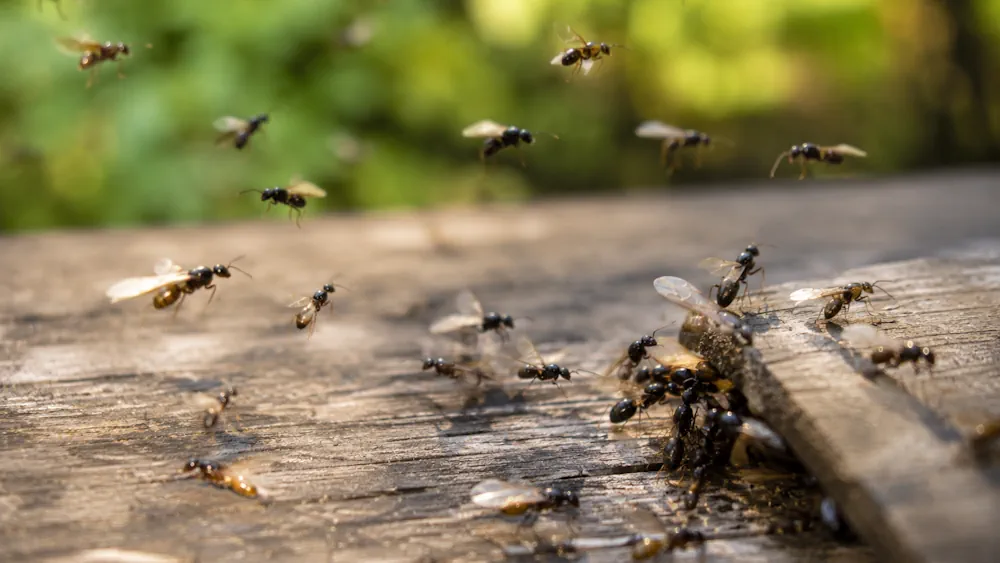
Flying ant day is the point in the year when black garden ant colonies release their winged reproductive ants, known as alates, all at the same time. Each colony contains a queen who spends most of the year producing worker ants, but once a nest matures, she also produces winged males and winged future queens. These are kept underground until conditions are right, then released together in huge numbers. It’s not one single nationwide event with a fixed date. Different colonies across the country trigger at slightly different times depending on local weather, so “flying ant day” can stretch across several days, or even a couple of weeks, rather than happening on one exact afternoon everywhere at once.
Why does it happen on a specific kind of day?
Ants don’t release their winged colonists at random. They wait for warm temperatures, low wind, and high humidity, usually after a spell of hot weather followed by rain or a drop in pressure. Calm, muggy conditions give the flying ants the best chance of mating mid-air and travelling far enough to start new colonies elsewhere. Windy days scatter them too much and reduce their chances of finding a mate, so colonies hold back until the weather settles. Because most of the UK experiences similar summer weather patterns around the same window, many colonies end up releasing their ants within days of each other. This is why it looks like the whole country is affected simultaneously.
The mating flight itself
Once conditions are right, winged males and queens leave the nest and take to the air in large swarms. This is often called a nuptial flight. Males mate with queens mid-flight, then die shortly afterwards, having served their only purpose. Mated queens land, break off their own wings, and search for a suitable spot to dig a new nest. From that single queen, an entirely new colony can grow over the following years. It’s a short, brutal, and highly efficient system. Out of the thousands of ants released, only a small number of queens will succeed in founding a new colony, but that’s enough to keep the population going year after year.
Why do you see so many at once
The sheer scale of a flying ant swarm often surprises people who’ve never seen one before. A single mature nest can release thousands of winged ants in one go, and because so many nests trigger within the same short weather window, gardens, parks, and even city pavements can appear covered in them for a few hours. Birds, particularly gulls and swifts, take full advantage of this, often gathering in unusually large numbers to feed on the swarms. If you notice gulls behaving oddly overhead on a hot July afternoon, a flying ant emergence nearby is often the reason.
When it typically happens in the UK
Most flying ant activity in Britain falls between mid-July and mid-August, though the exact timing shifts a little each year depending on the weather. A wet, cool summer can delay it, while a hot, dry one can bring it forward or spread it across several separate days as different regions hit the right conditions at different times. Scotland and the north tend to see it slightly later than the south of England, again purely down to temperature differences.
Should you worry about them?
Flying ants themselves aren’t dangerous. They don’t sting, they don’t bite in any meaningful way, and they die off naturally within a day or two of their flight. The bigger concern is what happens afterwards. If a mated queen finds her way into a wall cavity, under a patio, or inside a warm, sheltered part of your home, she can establish a new nest that grows steadily over the following seasons. A few flying ants in the garden for an afternoon are nothing to act on. Regular ant trails heading into the house, particularly near skirting boards, door frames, or kitchen worktops, are worth having checked. Since that pattern usually points to an established colony rather than a passing swarm.
Understanding flying ant day takes the mystery out of what looks, for one afternoon each summer, like a small-scale insect invasion. It’s simply thousands of ant colonies making the most of one good day to secure their future.