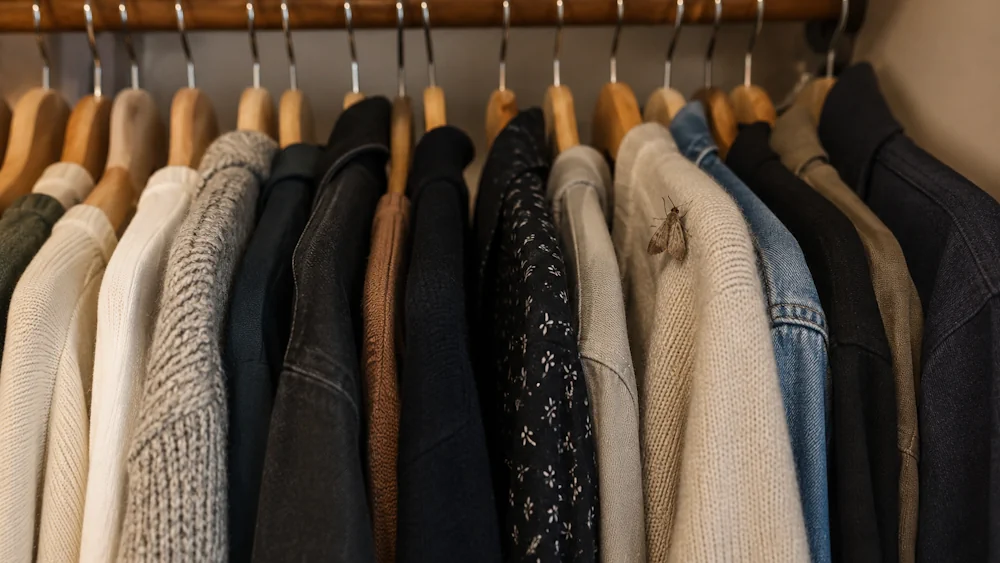
Why do I keep getting moths in my wardrobe?
You open the wardrobe, pull out a favourite jumper, and there it is: a small hole near the elbow. Maybe two. Then a pale little insect flutters out and bumps along the shelf. Annoying, yes. But that fluttering insect is rarely the real problem.
The moths you spot are the adults, and adult clothes moths don’t eat fabric at all. Most of them barely feed. Their one job is to breed. The damage comes from their young. So if you keep finding moths in your wardrobe, the honest answer is usually this: something in there is feeding their larvae, and the conditions are good enough that they keep coming back for more.
The grubs do the eating, not the moths
A female clothes moth lays dozens of tiny eggs, often tucked deep into the folds of wool or down at the bottom of a drawer. The eggs hatch into small cream-coloured caterpillars. These larvae are the ones chewing through your clothes. They feed for weeks, sometimes months, then spin into a cocoon and turn into the adult you finally notice. By the time you see a flying moth, several rounds of feeding may have already happened. That’s why a single sighting can mean far more damage than it seems.
What they’re after
Clothes moth larvae feed on keratin, a protein found in animal fibres. That puts your wool, cashmere, silk, fur, feathers and felt right on the menu. Cotton and polyester usually survive untouched, although a heavy mix garment can still get nibbled. This is the key thing people miss. The moths aren’t drawn to fabric for its own sake. They want the protein.
Why your wardrobe is basically a five-star hotel
Think about the spot from a moth’s point of view. It’s dark. It’s warm. Nothing disturbs it for months at a stretch. Clothes hang still, layered and pressed together, with quiet gaps no one ever checks. Add a bit of humidity, and you’ve built the ideal nursery. The back corners, the underside of a folded blanket, the seam of a coat you wore twice last winter: these are the places larvae love. Open, busy, well-aired storage gives them far less to work with.
The dirty laundry trap
Here’s the part nobody likes to hear. Moths go for worn clothing before clean clothing, every time. Sweat, skin flakes, food stains and hair all soak into the fibres, and that residue is a feast. A clean wool jumper is appealing. A clean wool jumper you wore three times and never washed is irresistible. So if you store things at the end of a season without washing them first, you’re handing the larvae a packed lunch.
How did they even get in?
They slip in through open windows on a warm evening. They hitch a ride on a second-hand coat, a charity-shop find, or an old rug brought down from the loft. Sometimes they arrive in a delivery. Once a single female is inside and finds a quiet woollen corner, the cycle starts, and it builds fast in a wardrobe left shut for weeks.
Getting rid of them
Start by emptying the wardrobe completely. Don’t shortcut this. Check every garment, paying attention to seams, cuffs and folds, and bag up anything showing holes, webbing or gritty specks. Wash what you can on a warm cycle, and freeze delicate woollens in a sealed bag for at least seventy-two hours to kill eggs and larvae. Vacuum the empty wardrobe thoroughly, including the corners, then wipe it down. Empty the vacuum straight afterwards, outside.
Keeping them out for good
Clean before you store, every single time. Use sealed bags or boxes for anything you won’t touch for months. Cedar and lavender put adults off a little, though neither will rescue a heavy infestation on its own. Open the wardrobe regularly and let some light and air in, because disturbance alone breaks the cycle. Pheromone traps are worth setting too, since they tell you whether adults are about before holes appear.
When it keeps coming back
Some infestations dig in deeper than a weekend clear-out can fix, especially when larvae have spread into carpets, underlay or soft furnishings beyond the wardrobe. That’s when professional treatment earns its keep, and PestFreeMike can help locate the source, treat it properly, and stop the next generation before it starts.